The term “law” is used in science, philosophy, and society. In physics, laws explain natural phenomena, while in social science, laws regulate human behavior. People often search for information about Newton’s second law, martial law, and Murphy’s law.
These concepts belong to different domains:
- Physics and motion science
- Political and legal systems
- Probability thinking and philosophy
Isaac Newton contributed significantly to classical mechanics by developing the laws of motion.
What is Newton’s Second Law of Motion?
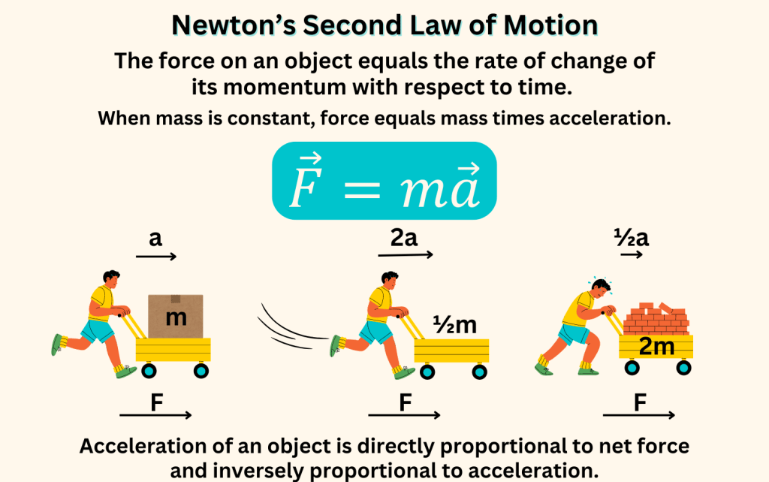
Newton’s second law explains the relationship between force, mass, and acceleration.
Newton’s second law states that the force acting on an object is directly proportional to its acceleration and inversely proportional to its mass.
Mathematically:
Force = Mass × Acceleration
Where:
- Force is measured in newtons
- Mass is measured in kilograms
- Acceleration is measured in meters per second squared
Newton’s second law is a fundamental principle of classical mechanics.
Importance of Newton’s Second Law
Newton’s second law helps explain motion in daily life.
Applications include:
- Vehicle acceleration
- Sports movement analysis
- Rocket propulsion
- Machine engineering
Understanding Newton’s second law is essential in physics education.
Real-Life Examples of Newton’s Second Law
Pushing a Shopping Cart
When pushing a shopping cart:
- Greater force increases acceleration
- Heavier carts require more force due to greater mass
Vehicle Motion
- Engine force and vehicle mass determine acceleration
- Sports cars demonstrate rapid acceleration due to high engine force
Sports Applications
Newton’s second law explains ball motion in sports such as cricket and football.
- Ball mass and kicking force influence movement speed.
What is Martial Law?
Martial law refers to a temporary military control over civilian governance.
Martial law is usually declared during:
- War conditions
- Political instability
- National emergencies
- Serious security threats
Military authorities may enforce law and order during such periods.
Meaning and Features of Martial Law
Martial law typically includes:
- Suspension of certain civil rights
- Military administration of regions
- Movement restrictions for citizens
- Emergency security enforcement
The purpose is to maintain national stability during crises.
Martial law differs from normal constitutional governance.
History and Background of Martial Law
Several countries have implemented martial law during war or political unrest.
- Implementation methods vary across nations.
- Some governments use martial law temporarily.
- Prolonged martial law can raise human rights concerns.
Social and Political Effects of Martial Law
Martial law can produce both positive and negative effects.
Positive effects:
- Improved security control
- Reduced violent disturbances
- Emergency crisis management
Negative effects:
- Restricted civil freedom
- Communication limitations
- Political tension
Understanding what martial law means is important for political studies.
What is Murphy’s Law?
Murphy’s law is a philosophical observation stating:
“Anything that can go wrong will go wrong.”
Murphy’s law is not a scientific law but a probability-based idea.
It represents human experience regarding unexpected failure.
Origin of Murphy’s Law
Murphy’s law is attributed to engineer Edward A. Murphy Jr., who worked on safety testing.
The concept became popular as a risk-awareness principle in engineering and life planning.
Real-Life Applications of Murphy’s Law
Murphy’s law encourages preparation and risk awareness.
Examples include:
- Carrying backup documents
- Checking equipment before use
- Maintaining safety measures
Project workers and engineers often apply this philosophy.
Difference Between Newton’s Second Law and Murphy’s Law
| Aspect | Newton’s Second Law | Murphy’s Law |
|---|---|---|
| Field | Physics | Philosophy |
| Nature | Scientific law | Observational idea |
| Formula | Force = Mass × Acceleration | No mathematical equation |
| Purpose | Explain motion | Describe probability of failure |
Newton’s second law is a scientific principle, while Murphy’s law is a practical life observation.
Martial Law vs. Constitutional Governance
Martial law differs from regular legal governance.
During martial law:
- Military authorities may control administration
- Civil courts may have limited authority
- Emergency rules may be applied
Knowing what martial law is helps understand national security policies.
Educational Importance of These Laws
Physics Education
Newton’s second law is essential for scientific learning.
Political Education
Studying martial law improves awareness of governance systems.
Risk Management Thinking
Murphy’s law helps develop practical planning skills.
These ideas together represent science, society, and philosophy.
Modern Applications of Newton’s Second Law
Applications include:
- Space engineering
- Robotics design
- Mechanical manufacturing
- Automotive safety systems
Engineers use Newton’s second law to calculate mechanical strength.
Psychological Meaning of Murphy’s Law
Murphy’s law reflects human response to uncertainty.
It encourages planning and preparedness.
Many people use Murphy’s law humorously when facing challenges.
Importance of Scientific and Social Knowledge
Students who understand Newton’s second law perform better in physics.
Knowing what martial law is increases political awareness.
Murphy’s law promotes practical thinking about risk.
Educational institutions teach these concepts to develop analytical skills.
Future Relevance of These Concepts
- Newton’s second law will remain fundamental in physics.
- Martial law will continue to be discussed in national security contexts.
- Murphy’s law will remain a philosophical risk-awareness idea.
Scientific research will continue expanding classical mechanics.
Final Thoughts
Newton’s second law, martial law, and Murphy’s law represent knowledge across science, politics, and philosophy.
The work of Isaac Newton revolutionized motion science.
Understanding what martial law means improves political literacy.
Murphy’s law helps people prepare for uncertainty and risk.
These ideas are important for education, scientific understanding, and social awareness.
Learning Newton’s second law supports physics knowledge, studying martial law improves civic awareness, and understanding Murphy’s law helps real-world planning.